Quick answer: In a typical integrated township, security is strongest at the entrance and fades the deeper you go. The real test isn’t how well the main gate works — it’s whether that protection stays unbroken all the way to a resident’s front door. It usually doesn’t, because different parts of the community run on different systems that don’t talk to each other. Onetouch closes those gaps by connecting the whole journey into one seamless ecosystem, so safety follows a resident home instead of stopping at the boundary wall.
If you build homes, this is really a question about trust. As a family head, you want your own family to feel safe wherever you live. Every buyer walking through your project wants exactly the same thing. So the honest question is whether your current security setup actually delivers that feeling — or just looks like it does at the entrance.
It’s a question worth taking seriously. India’s real estate market is worth around ₹44 lakh crore ($532 billion) and is set to nearly double by 2034, and safety has quietly become the factor that tips a buyer’s decision. Almost half of all smart-home buyers say security is their main reason to upgrade — and in a township, that instinct doesn’t stop at the gate.
Where the Gaps Actually Hide
Most communities look secure. There’s a guarded entrance, maybe a barrier, a register to sign. But once a visitor is past that first point, what really keeps track of where they go — through the lobby, into the lift, up to a floor?
Too often, nothing joins those moments together. The entrance runs on one system, the lobby on another, the lift and the front door on something else again — frequently from different vendors who never designed their products to work as a set. Each point does its own small job, but the spaces between them go unwatched. And it’s precisely in those in-between moments that a resident’s sense of safety quietly slips.
That fragmentation is also a headache for the people building and running the community — five systems to buy, integrate and maintain, none of them giving a single clear picture of what’s happening across the property.
How Onetouch Removes the Gap
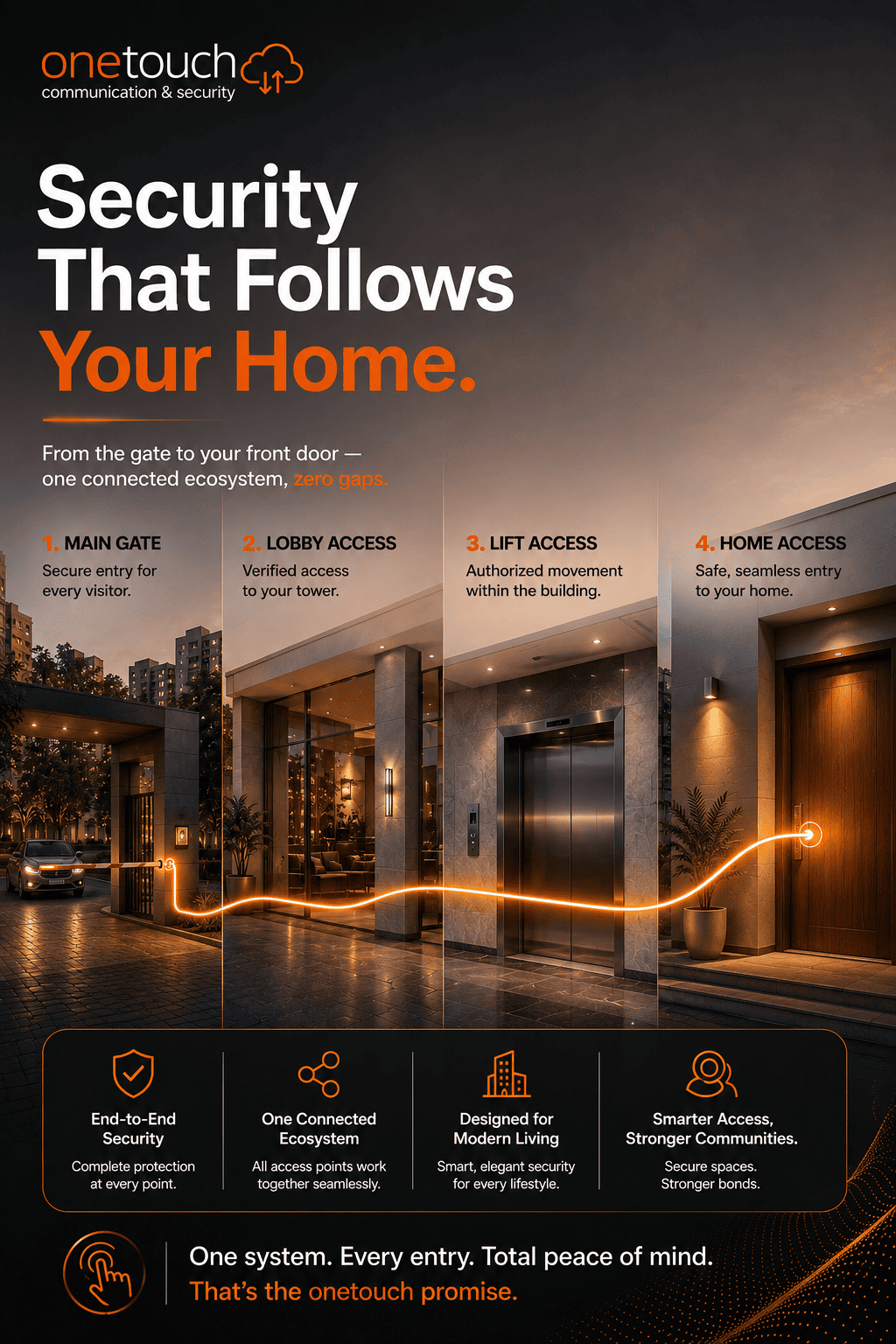
This is the idea Onetouch is built around: security shouldn’t be a series of separate checkpoints, but one continuous chain. Instead of stitching together disconnected devices, it connects the entire path a person takes — from the main gate, through the lobby and lift, right up to the apartment door — into a single, seamless ecosystem.
Because it all works as one, there are no blind spots between the layers. A visitor verified at the entrance is accounted for the whole way; a resident simply moves through a community that recognizes them and opens up, while everyone else stays exactly where they should be. For management, it means one connected view of the property, around the clock, rather than paper logs and guesswork.
That’s the quiet difference — not more gadgets bolted on, but the gaps between them removed. India’s smart-home market is growing at nearly 30% a year, and this is what “smart security” is really meant to be: joined-up, not scattered.
Why It’s an Edge for Developers
For a developer, protection that runs gate-to-door as one ecosystem isn’t just reassuring — it’s a genuine advantage. It speaks directly to what buyers care about most, it lifts the perceived value of the whole project, and it replaces the mess of managing many vendors with a single, cleaner system. Most of all, it gives families a promise they remember long after the site visit: that they’ll feel safe everywhere in the community, not just at the entrance.
The Bottom Line
Integrated townships won people over by bringing everything they need into one place. The natural next step is to protect it all as one place, too. Real security isn’t a strong gate followed by a shrug — it’s an unbroken line from the main entrance to the front door.
That’s exactly the gap Onetouch closes: one connected system that follows every resident safely, all the way home.
Frequently Asked Questions
What makes an integrated township “secure”?
True security in a township is continuous — the entrance, lobby, lift and front door all work together as one connected system, so there are no unwatched gaps between them.
Why isn’t a guarded gate enough?
A gate only secures the first point of entry. Without a connected system, there’s little tracking what happens after — which is where most risk actually sits.
How does Onetouch make a community safer?
It links the whole journey from gate to door into a single ecosystem, removing the blind spots between separate devices and giving management one clear, 24×7 view.
Why does this matter for developers?
Gate-to-door security as one ecosystem raises a project’s value, simplifies operations, and answers the safety concerns buyers rank above almost everything else.